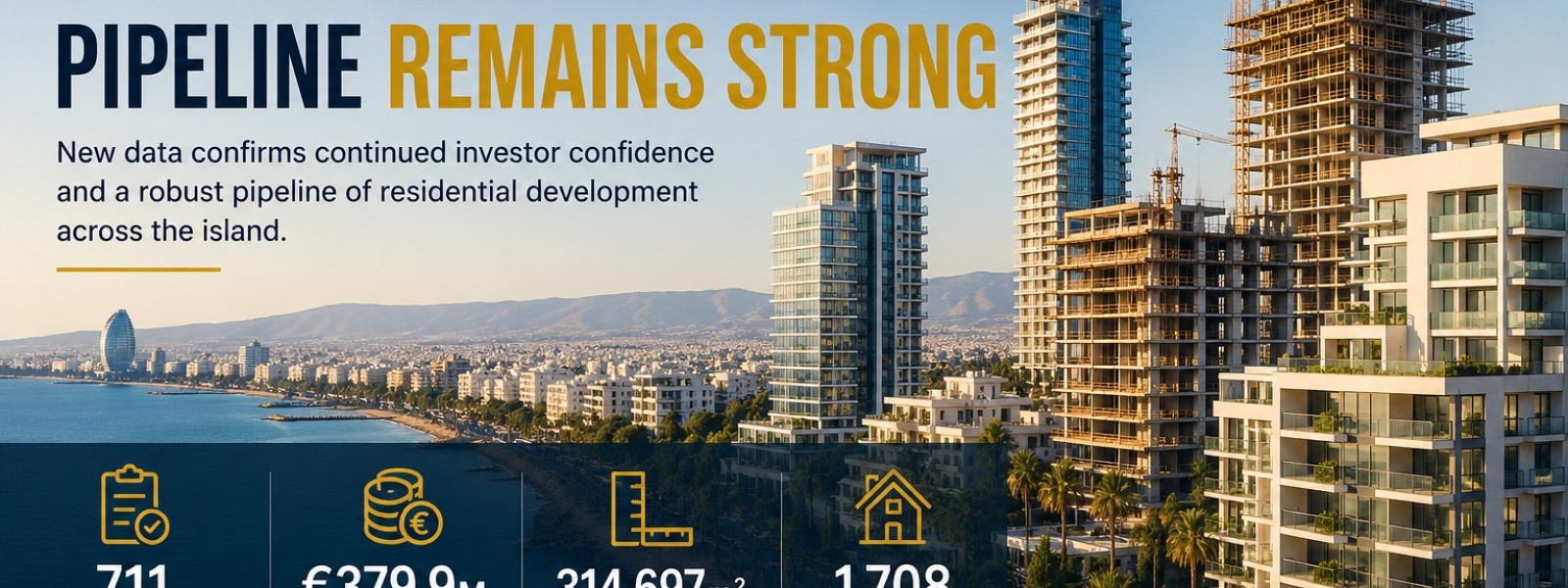
Quick answer: Cyprus authorised 711 building permits in February 2026, worth €379.9 million and covering 314,697 square metres for 1,708 new dwelling units. The construction pipeline is expanding sharply — permits across the first two months of 2026 rose almost 49% year-on-year. For Limassol buyers, the real question is not whether supply is coming, but whether it lands at the price points the market actually needs, or simply adds more high-end inventory to an already premium city.
The headline numbers
The latest data from the Cyprus Statistical Service (CyStat) confirms that the island's development engine is running hot. In February 2026 alone, authorities cleared 711 building permits with a combined value of €379.9 million. Those permits cover 314,697 square metres of construction and provide for 1,708 new dwelling units.
Taken in isolation, a single month tells you little. The trend behind it tells you everything. Across January and February 2026 combined, Cyprus issued 1,500 building permits, up from 1,008 in the same period a year earlier — a 48.8% year-on-year increase. The total value of those permits climbed 56.5%, the total area rose 54.9%, and the number of planned dwelling units jumped 79.2%, reaching 3,463 against 1,932 a year before.
That is not incremental growth. That is a step-change in the volume of residential product moving through the regulatory pipeline.
Why building permits are a leading indicator worth watching
Building permits sit upstream of everything that eventually reaches the market. A permit is the formal approval that allows construction to begin, which means today's permit numbers are a preview of the apartments and houses that will be completed in roughly 18 to 36 months. For anyone making a buying or investment decision in 2026, permit data is one of the cleanest forward-looking signals available.
Permits do two things at once. First, they confirm future supply — more permits today means more completed units tomorrow. Second, and more subtly, they reveal developer confidence. Developers do not commit capital to projects they expect to struggle selling. A 79% surge in planned dwelling units is a direct statement that the people closest to the market still see robust demand ahead.
In other words, the supply story and the demand story are the same story. The pipeline is filling because developers believe buyers will be there to absorb it.
The supply-versus-price-point question for Limassol
Here is where national headlines stop being useful and local nuance takes over.
Cyprus is not a single market. It is five district markets — Limassol, Nicosia, Paphos, Larnaca, and Famagusta — with very different dynamics. Limassol has spent the last decade as the island's premium magnet: the centre of gravity for shipping, technology relocations, branded residences, and international high-net-worth buyers. That status comes with a structural tension. Limassol's coastline is largely built out, land is scarce and expensive, and the city has developed vertically. When new supply does arrive, it tends to arrive at the top of the price ladder.
So the critical question for Limassol is not "is supply coming?" The answer to that is clearly yes. The question is "what kind of supply?"
If the new pipeline skews heavily toward luxury seafront towers and branded residences, it does little to relieve pressure in the mid-market, where genuine demand from relocating professionals and domestic buyers is most intense. If, on the other hand, developers are starting to build for the €300,000–€600,000 band, that broadens the market and improves liquidity across the board.
Early 2026 pricing data tells us where the gaps are. In Limassol, studios and one-bedroom apartments average around €190,000, two-bedroom apartments around €380,000, and three-bedroom apartments around €560,000. In prime sub-markets the numbers run far higher — two-bedroom apartments in the Germasogeia tourist area average around €520,000, and in Neapolis around €620,000. The spread between "entry Limassol" and "prime Limassol" is wide, and most of the demand pressure sits in the middle.
What the price indices are actually saying
A surge in permits does not automatically translate into falling prices. Supply takes years to complete, and demand in Cyprus has consistently outrun delivery.
The Central Bank of Cyprus Residential Property Price Index accelerated from a 4.84% year-on-year increase in Q1 2025 to 7.06% in Q4 2025, with apartments — the segment under the most demand pressure — rising 9.61% year-on-year. Limassol recorded the strongest annual increase in the overall residential index of any district, at 9.90% in Q4 2025.
The most recent RICS Cyprus Property Index with KPMG, covering Q1 2026, describes a market that has cooled from a sprint to a steady walk rather than reversing. KPMG reported that the market remained broadly stable in the first quarter, with marginal price movements across most districts and asset categories, apartments continuing to lead, and Limassol showing only modest changes alongside selective growth in housing values. Rental values, meanwhile, kept climbing, with apartments posting the largest annual increases.
The picture that emerges is a market that is still demand-led but no longer overheating. The Central Bank has said it sees no signs of widespread overvaluation. That is an important nuance: strong permit numbers are arriving into a market that has room to absorb them without an obvious price cliff.
The structural constraint nobody can permit their way out of
There is a counter-current to the supply surge that is easy to miss in the raw permit figures: getting a permit is not the same as completing a building.
Industry leaders have repeatedly flagged that insufficient supply remains the market's main structural challenge, with delays in the development licensing system and shortages of skilled labour constraining how quickly new projects actually reach completion. Construction costs also remain at historically elevated levels, which keeps replacement values high and limits how aggressively developers can price new units downward.
This matters enormously for interpreting the permit data. A 79% jump in planned dwelling units is real, but the bottleneck shifts from approval to delivery. If labour and licensing constraints stretch timelines, the supply relief that buyers might hope for gets pushed further out — and prices stay supported for longer than the headline permit numbers would suggest.
What this means for different types of buyer
For the luxury and lifestyle buyer
Limassol's prime segment remains structurally tight. Scarce coastal land, branded-residence demand, and international capital mean the top of the market is unlikely to soften meaningfully even as the pipeline grows. If you are buying at this level, the decision is driven by product quality, location, and developer track record rather than by waiting for a supply-led price correction that is improbable in the prime band.
For the investor
Limassol consistently delivers the strongest rental yields of any major Cypriot city, and rental values are still rising while sale-price growth moderates — a combination that supports income returns. Efficient one-bedroom and studio units in central neighbourhoods tend to offer the best yields, while larger units underperform on a yield basis. The incoming supply is worth watching closely: a wave of completions in a specific sub-market could compress rents there, so unit selection and location discipline matter more than ever.
For the relocating professional or mid-market buyer
This is the cohort the pipeline most needs to serve. Demand from shipping, tech, and professional-services relocations continues to outpace mid-market inventory, which is why rents have climbed 8–12% year-on-year. More supply is broadly good news here — but only if developers build for this band rather than defaulting to luxury. The neighbourhoods to watch are the "catch-up" areas such as Zakaki and Mesa Geitonia, where buyers priced out of the seafront are finding comparable quality at meaningfully lower entry points.
The Cyprino read
At Cyprino, we interpret the February permit data as confirmation of a healthy, confident market rather than a warning of oversupply. The pipeline is strong because developers see demand, and the demand is real. But the national headline flattens a more important local truth: Limassol's challenge has never been a shortage of construction activity — it has been a shortage of the right construction at the right price points, delivered on a realistic timeline.
For buyers and investors, the practical takeaways are straightforward. First, do not expect the permit surge to trigger a near-term price drop in prime Limassol; the structural constraints on delivery and the depth of international demand make that unlikely. Second, watch sub-market supply rather than national totals — a completion wave in one neighbourhood affects that neighbourhood, not the city as a whole. Third, in a market that is normalising rather than reversing, the edge goes to buyers who move with good intelligence and a clear view of where genuine value sits.
That is precisely where a boutique, locally-embedded agency earns its keep. National statistics are a starting point. Knowing which specific projects are entering the pipeline, at what price points, in which neighbourhoods, and on what realistic timelines is the difference between buying the headline and buying the right asset.
Frequently asked questions
How many building permits did Cyprus issue in February 2026?
Cyprus authorised 711 building permits in February 2026, with a total value of €379.9 million, covering 314,697 square metres and providing for 1,708 dwelling units.
Is Cyprus building permit activity increasing in 2026?
Yes, significantly. In the first two months of 2026, Cyprus issued 1,500 building permits, up 48.8% from 1,008 in the same period of 2025. Planned dwelling units rose 79.2% year-on-year to 3,463.
Will more supply lower property prices in Limassol?
Not in the near term, and probably not in the prime segment. Limassol prices rose roughly 9.9% year-on-year in late 2025, demand from international and relocating buyers remains strong, and delivery constraints — licensing delays, labour shortages, high construction costs — mean new supply reaches completion slowly. The Central Bank of Cyprus reports no signs of widespread overvaluation.
What is the average apartment price in Limassol in 2026?
As of early 2026, one-bedroom apartments average around €190,000, two-bedroom apartments around €380,000, and three-bedroom apartments around €560,000, with prime coastal sub-markets such as Germasogeia and Neapolis running considerably higher.
Which Limassol areas offer the best value in 2026?
"Catch-up" neighbourhoods such as Zakaki and Mesa Geitonia are projected to see above-average price growth, offering comparable quality to the seafront at lower entry points, supported by strong rental demand and improving infrastructure.
Cyprino is a boutique luxury real estate agency based in Limassol, Cyprus, specialising in high-net-worth residential acquisitions and investment property. For tailored market intelligence on specific developments and price points, get in touch at 99573499
Sources: Cyprus Statistical Service (CyStat); RICS Cyprus Property Index with KPMG in Cyprus (Q1 2026); Central Bank of Cyprus Residential Property Price Index. Figures current as of June 2026.