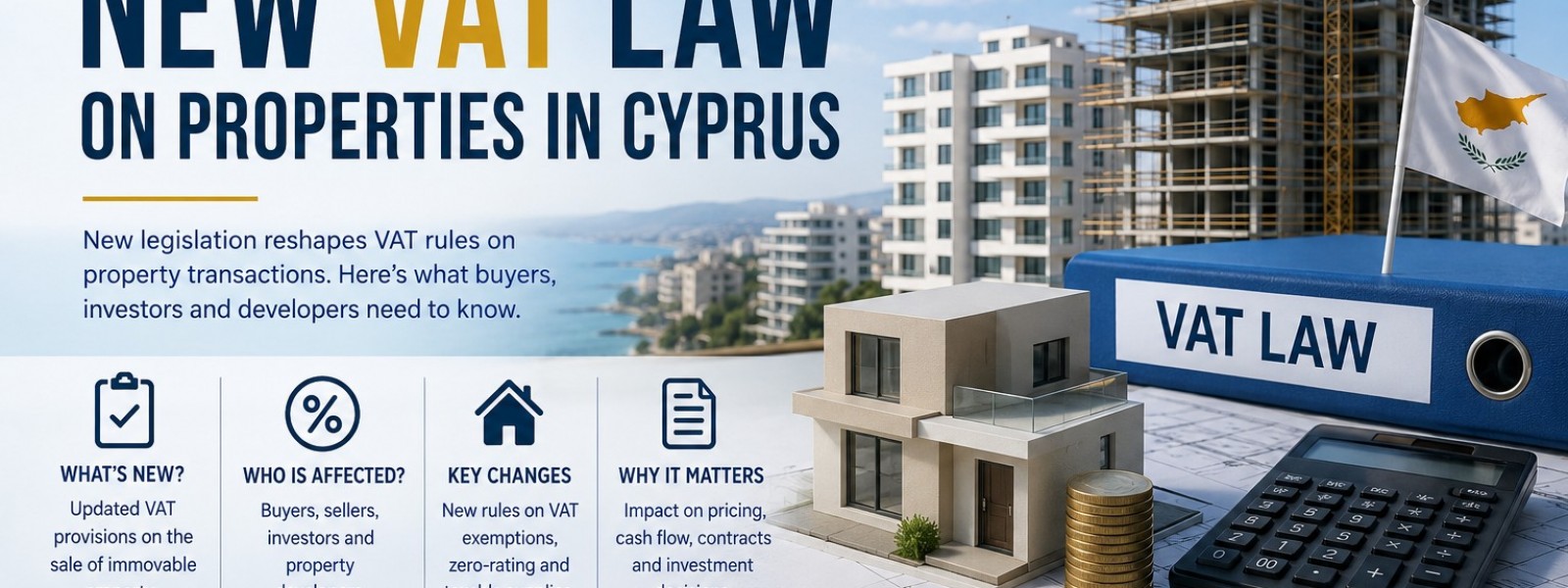
The new VAT law in Cyprus ends the favourable 5% scheme on 15 June 2026. See how the rules change, who qualifies, and why timing matters for buyers.”
slug: new-vat-law-cyprus-property-2026
canonical: https://cyprino.com/blog/new-vat-law-cyprus-property-2026
New VAT Law in Cyprus Property (2026): What Buyers & Investors Must Know
A quiet but significant shift is happening in Cyprus real estate. The **new VAT law Cyprus** introduced in 2023 has been running alongside the old, more generous regime for almost three years. On **15 June 2026**, that grace period ends. From **1 September 2026**, further changes to how VAT is assessed on buildings take full effect.
If you are planning to **buy property in Cyprus** — whether as a primary home, a long-term asset, or a lifestyle investment in Limassol — the next few months are the most important window you will see in a decade. This guide explains what is actually changing in **cyprus vat properties**, what the transitional rules allow, and how to position yourself before the rules tighten.
1. Overview of VAT on Cyprus Property
VAT is one of the biggest single cost items when buying a newly built home in Cyprus. It is charged on the **first sale** of a new property, typically from a developer to a buyer. Resale properties are generally VAT-exempt and subject to transfer fees instead.
There are two headline rates you need to know:
- **19% standard VAT** — applied to new properties, investment purchases, holiday homes, and any property that does not meet the reduced-rate criteria.
- **5% reduced VAT** — applied only to a primary and permanent residence, under strict conditions.
For a developer-built apartment in Limassol at €600,000, the difference between the two rates is €84,000. That is not a rounding error — it is the price of a car, or several years of property management fees. This is why **vat on property cyprus** is the single most important tax question any serious buyer needs to understand before signing a reservation agreement.
-----
2. What Changed in the New VAT Law (2023–2026 Updates)
The **new VAT law Cyprus** — Law 42(I)/2023, enacted in June 2023 — was a direct response to pressure from the European Commission, which had opened an infringement case against Cyprus over the previous regime. The old 2016 rules applied the 5% rate to the **first 200 sqm** of any primary residence, regardless of overall size or value. High-end villas worth several million euros were qualifying for the same tax break as modest family homes. The EU pushed back. Cyprus responded.
Under the new system, the 5% rate only applies if **all** of the following are true:
- The property is used as the buyer’s **primary and permanent residence** for a minimum of **10 years**.
- The buyer is a natural person (companies are excluded — they always pay 19%).
- Total internal area does **not exceed 190 sqm**.
- Total transaction value does **not exceed €475,000**.
- The 5% rate itself only applies to the **first 130 sqm** and the **first €350,000** of value. Anything above is taxed at 19%.
- The reduced rate has not previously been applied to the same property by another buyer.
If a property breaches either the 190 sqm or €475,000 ceiling, the reduced rate is lost **entirely** — 19% applies to the whole transaction.
This is a fundamentally different scheme. It targets genuine first-home buyers and filters out investment, rental, and luxury-tier purchases from the reduced rate.
-----
3. The 2026 Deadline & Government Extension Explained
Here is where timing becomes everything.
When the new law passed in June 2023, the government built in a **three-year transitional window** to protect projects already in the pipeline. Under this extension:
- If a developer submitted a **planning permit application before 31 October 2023**, buyers of those properties can still access the **old 200 sqm / no-value-cap regime**.
- The application for the reduced VAT rate under the old rules must be submitted by **15 June 2026**.
- After that date, the transitional provisions expire permanently. Every transaction falls under the stricter new system.
On top of this, a second set of amendments comes into force on **1 September 2026**. These redefine what counts as a “new” versus a “used” building for VAT purposes — shifting from a simple 5-year time test to a “first occupation” and “first use” test. In practice, this tightens how developers can structure sales of unsold inventory and closes several workarounds that existed under the old framework.
The net effect: from mid-to-late 2026 onward, **cyprus property vat 2026** rules become uniform, stricter, and less forgiving of complex deal structures.
-----
4. Old vs New VAT Rules (Clear Comparison)
The difference is easiest to see side by side.
|Element |Old Regime (until 15 June 2026)|New Regime (after 15 June 2026)|
|----------------------|-------------------------------|-------------------------------|
|5% rate applies to |First 200 sqm |First 130 sqm |
|Maximum property area |No cap |190 sqm total |
|Maximum property value|No cap |€475,000 total |
|Value cap for 5% rate |No cap |€350,000 |
|Eligible for |Primary residence, 10-year use |Primary residence, 10-year use |
|Available to companies|No |No |
|Deadline to apply |15 June 2026 |Ongoing |
Consider a real-world example. A 180 sqm villa priced at €650,000:
- **Under the old rules** (planning permit pre-October 2023): 5% VAT on the first 200 sqm — the entire €650,000 qualifies for the reduced rate. **Total VAT: €32,500.**
- **Under the new rules:** The value exceeds €475,000, so the reduced rate does **not apply at all**. The full 19% is charged. **Total VAT: €123,500.**
A difference of **€91,000** on a single transaction. This is why the window between now and June 2026 is not a marketing angle — it is a genuine fiscal event.
-----
5. How This Impacts Property Buyers
The practical implications depend on what you are buying and why.
**If you are buying a primary residence under 130 sqm and under €350,000**, relatively little changes. You qualify under both regimes.
**If you are buying a primary residence between 130 sqm and 190 sqm, or between €350,000 and €475,000**, the old rules are significantly more favourable. Acting before 15 June 2026 can save you tens of thousands of euros — provided the property’s planning permit was filed before 31 October 2023.
**If you are buying above 190 sqm or above €475,000**, the new rules eliminate the 5% rate entirely. The old regime is the only route to a reduced rate, and only for eligible projects. After June 2026, you pay 19% on the full price.
**If you are buying as an investment, through a company, or as a holiday home**, the 19% rate applies regardless. But the “first occupation” redefinition taking effect on 1 September 2026 changes how developers can treat unsold stock, which has downstream implications for pricing and deal structures.
The buyers most exposed are those in the mid-to-upper segment — exactly the **cyprus property investment** tier where Limassol has seen the strongest activity over the past five years.
-----
## 6. Why 2026 Is a Critical Window for Investors
There are three reasons the current window matters beyond the headline tax saving.
**First, supply is shrinking.** Only projects with planning permits filed before 31 October 2023 qualify for the old regime. As those projects sell through, the inventory of eligible stock disappears. Every month closer to June 2026, the options narrow.
**Second, the market has already priced some of this in — but not all.** Developers know the deadline. Serious buyers know the deadline. But the broader international market still underestimates how fast the transitional window is closing. That creates a temporary inefficiency for buyers who move decisively.
**Third, Cyprus remains structurally attractive regardless of VAT.** The country has no capital gains tax on securities, favourable treatment of non-dom status, an EU legal framework, and — in Limassol specifically — one of the most internationalised property markets in Southern Europe. The VAT window is not the reason to buy **cyprus real estate**. It is the reason to stop waiting.
After June 2026, **cyprus real estate tax** rules become harmonised and less flexible. The strategic optionality of the current dual regime disappears.
-----
## 7. Strategic Advice for Buyers (Investment Angle)
Three practical recommendations for buyers considering the Cyprus market right now:
- **Verify the planning permit date before you verify anything else.** A property’s eligibility for the old VAT regime lives or dies on whether its permit application was filed before 31 October 2023. Ask for documentary proof. This is not a detail — it is the entire basis of the tax treatment.
- **Model both scenarios before you negotiate.** The VAT exposure on a property can swing the effective purchase price by 10–15%. Run the numbers under the old and new regimes. Use that to calibrate your offer, not just to understand your cost.
- **Move on the application, not just the contract.** The deadline is the submission of the reduced VAT application by **15 June 2026**, not the completion of the transaction. Align your legal team, bank, and developer accordingly. Applications submitted late will fall under the new rules regardless of when the contract was signed.
For serious investors, there is a fourth point worth considering: the **5% vat cyprus property** scheme only applies to primary residences held for 10 years. If you are buying for rental yield or future resale, you are paying 19% regardless — and the new “first occupation” rules from September 2026 change how your exit is taxed. Structure the purchase with the exit in mind.
> **Internal linking suggestions:**
>
> - “Browse our current [**cyprus property for sale**](https://cyprino.com/properties) in Limassol”
> - “See our [Limassol new developments](https://cyprino.com/new-developments) with pre-2023 planning permits”
> - “Read our guide to [buying property in Cyprus as a foreign investor](https://cyprino.com/blog/buying-property-cyprus-guide)”
8. Conclusion: Act Before the Window Closes
The new VAT law in Cyprus is not an abstract tax reform. It is a specific, dated, measurable change in how **cyprus vat properties** are treated — and it creates a genuine time-limited advantage for buyers willing to act before 15 June 2026.
After that date:
- The old 200 sqm regime is gone.
- The 5% rate is capped at 130 sqm and €350,000.
- Properties above €475,000 lose access to the reduced rate entirely.
- The definition of “new” versus “used” property tightens further on 1 September 2026.
The buyers who will look back on 2026 as a turning point are the ones who moved while the old rules were still available.
At Cyprino, we work exclusively with developers and projects in Limassol where VAT eligibility is verified upfront — including inventory that still qualifies under the pre-October 2023 planning regime. If you are considering buying in Cyprus and want a clear, honest assessment of your VAT exposure on a specific property, we can walk you through it before you commit.
**Speak to Cyprino directly:https://www.cyprino.com/contact
The window is open. It will not stay open much longer.
-----
*This article is provided for informational purposes and does not constitute legal or tax advice. VAT treatment depends on the specific facts of each transaction. Consult a licensed tax advisor before making a purchase decision.*